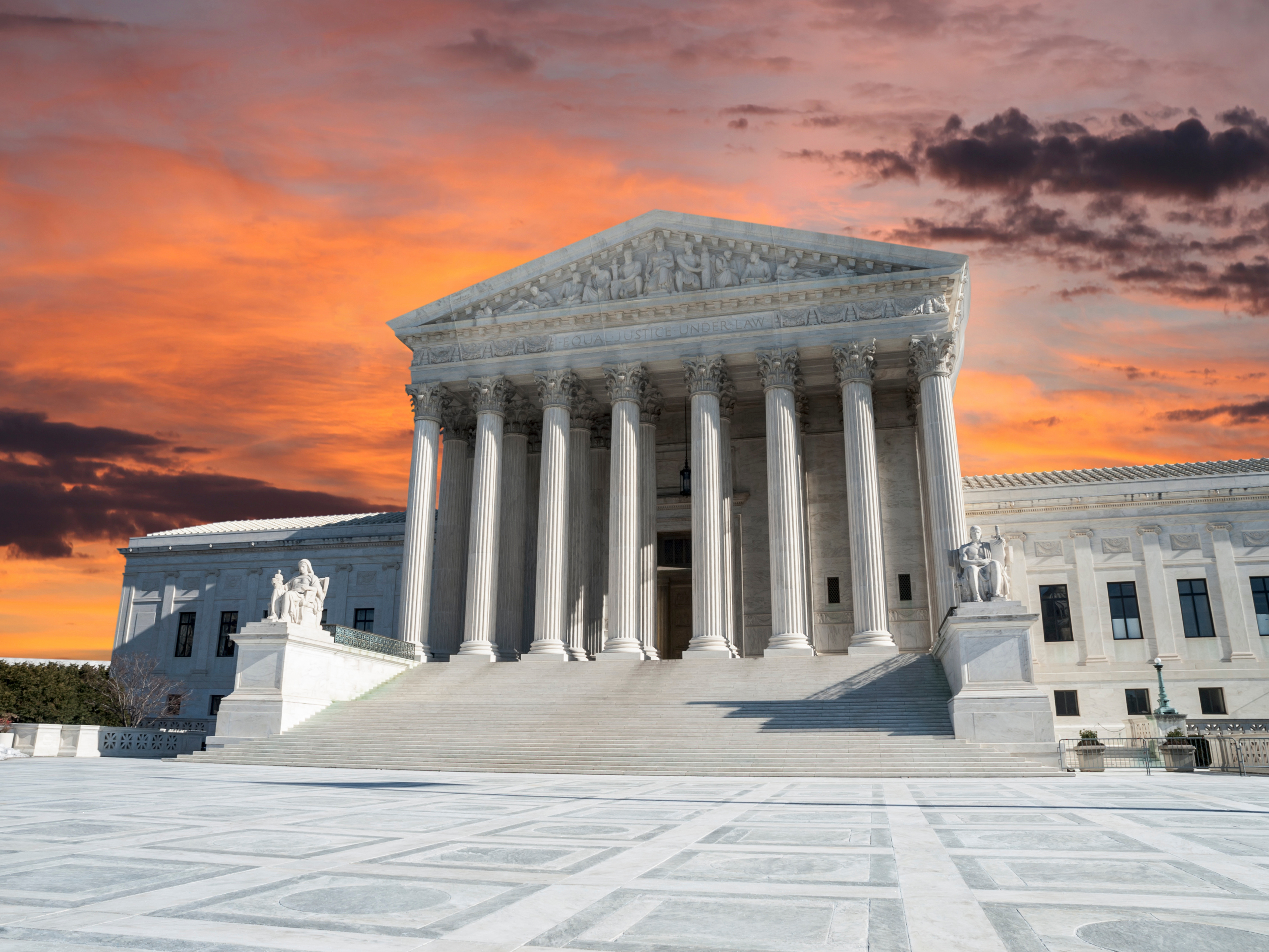
In a unanimous decision, the Supreme Court of the United States on Wednesday upheld a series of U.S. Food and Drug Administration decisions denying market authorization for flavored vaping products. The justices sent the case back to an appeals court for further review.
While the ruling is a partial win for the FDA, uncertainty remains over whether President Donald Trump’s administration will take steps to expand access to flavored vaping products. During his campaign, Trump pledged to “save vaping.” The vaping companies also still have the option to reapply for FDA approval.
Justice Samuel Alito authored the opinion for a unanimous Court.
Alito wrote that the vaping companies “express frustration about the lack of clear prior notice regarding the type of scientific evidence that was essential for approval of an application, but we cannot agree with their argument that the FDA went back on any commitments made in the guidance it provided before ruling on respondents’ applications.
“We thus conclude that (the companies) failed to show that the FDA changed its position with respect to the scientific evidence supporting premarket tobacco product applications.”
Tony Abboud, executive director of the Vapor Technology Association (VTA), said he was deeply disappointed by the Court’s ruling in the case. He said the decision is an “endorsement of the FDA’s shifting conduct, and we strongly disagree with its implications” for the vaping industry and the millions of adult consumers who rely on flavored products as a harm reduction tool.
“This ruling underscores the urgent need for decisive action from the Trump Administration to resolve ongoing – and future – litigation by eliminating once and for all the regulatory uncertainty plaguing the FDA,” said Abboud. “President Trump’s FDA can establish clear and fair guidance that supports innovation and ensures the survival of the small businesses that make up the U.S. vaping industry.
“The future of flavored vaping now lies in President Trump’s hands, and we urge him to fulfill his campaign promise to save flavored vaping— the most effective tool available to quit smoking deadly cigarettes.”
The case may not matter if Trump follows through with his promise to flavored vaping as Abboud suggests. On April Fools Day, Trump wasn’t joking when he placed Brian King, director of the FDA’s Center for Tobacco Products (CTP), on administrative leave.
Health and Human Services (HHS) Secretary Robert F. Kennedy Jr., a known user of nicotine pouches, has said that more than 3,500 more employees will be leaving the FDA. Sources have also confirmed that Todd Cecil, deputy director of Regulatory Management, and Matt Farrelly, director of Office of Science, have been reassigned. King’s removal aligns with broader staff reductions at the FDA, including the dismissal of nearly the entire office responsible for enforcing tobacco regulations.
The United States Supreme Court heard in December oral arguments in FDA v. Wages and White Lion Investments LLC (doing business as Triton Distribution). The case is about much more than saving the vaping industry; it is also a landmark case for regulatory accountability related to public health and consumer choice. It now heads back to an appeals court for further review.
The case will return the 5th Circuit Court of Appeals, which has been more favorable to vaping companies in legal challenges against the FDA, particularly regarding premarket tobacco product applications (PMTAs) for flavored e-cigarettes.
Triton’s attorney Eric Heyer explained to the court during oral arguments that the FDA’s policy could change under Trump because “the President-elect is on record saying, ‘I’m going to save flavored vapes;’ we don’t know exactly what that’s going to look like,” Heyer said.
At issue in White Lion is whether the FDA acted “arbitrarily and capriciously” when denying numerous PMTAs as alleged by the manufacturers and affirmed by the U.S. Court of Appeals for the 5th Circuit, which accused the FDA of a “regulatory switcheroo.”
Elizabeth Hicks, U.S. affairs analyst for the Consumer Choice Center, stated that the case underscores the need for “fairness and transparency” in regulatory processes. “The FDA’s blanket denials have placed enormous hurdles on firms providing harm-reduction alternatives, potentially decimating an industry that millions of adult consumers rely on to transition away from smoking traditional cigarettes,” she said.
The justices took up the FDA’s appeal, filed after a lower court ruled that the agency had failed to follow proper legal procedures under federal law when it denied the applications to bring their nicotine-containing products to market. The full slate of 5th Circuit judges ruled 10-6 that the FDA had been “arbitrary and capricious,” violating a federal law called the Administrative Procedure Act, by denying the applications without considering the companies’ plans to prevent underage access and use.
During oral arguments, Associate Justice Clarence Thomas called the FDA guidance “a moving target” that shifted throughout the process. Also, Associate Justice Neil Gorsuch stated that applicants were not granted conditions for jury trials in administrative cases, as the court outlined in SEC v. Jarkesy. Gorsuch also wondered if the agency had failed to give applicants fair notice that the rules had changed.
Chief Justice John Roberts asked Deputy Solicitor General Curtis Gannon, the government’s lawyer, during the December hearing, whether the government has “an obligation to tell people what they have to do to comply with your regulation.”
Gannon replied that the FDA gave these vaping businesses fair notice that their business model is “risky.” As to the evidence the companies presented, “they were barking up the right tree,” said Gannon, but “they didn’t have sufficient scientific evidence” to satisfy the statute’s requirements.
Justice Brett Kavanaugh seemed to have sympathy for the FDA’s case. He said it was clear from the outset what the FDA’s position on issuing denial orders was: a focus on the harm to young people that flavored vape products bring. He noted that under the Tobacco Control Act, the FDA has the power to regulate tobacco products with a special focus on youth. If, after weighing the evidence, the FDA rejects an application, “It’s kind of the end of it, isn’t it?” Kavanaugh asked.
Hicks said the FDA’s rejection of Triton’s and Vapetasia’s (a co-respondent) applications demonstrates a failure to balance or even understand public health priorities and opportunities provided by less harmful nicotine products.
“While we all agree on the need to keep these products out of the hands of young people, denying adult smokers access to safer alternatives like flavored vaping devices could have dire consequences for harm-reduction efforts,” Hicks said. “Regulatory decisions should be evidence-based, not rooted in unachievable or shifting standards that are unreasonable to provide.”
Heyer told the justices that many small vaping companies would be forced to shut their doors without the FDA authorizing more flavors. But Kagan replied that “the difficulty with that, and the FDA, I think, has tried to document this, is that blueberry vapes are very appealing to 16-year-olds not 40-year-olds.”
There is, however, one side issue in the case that could cause the FDA a headache. In their applications, the vaping companies were supposed to lay out what safeguards they had in place—such as requiring retail sellers of vapes to check IDs—to prevent young people from buying nicotine products.
The FDA admits it did not even bother to evaluate these sections of many vaping companies’ applications, and the government doesn’t defend its nonaction on these sections of the applications.
Instead, the government claims its error was harmless. The applications would have been denied anyway because the FDA had already denied other applications proposing similar safeguards against youth vaping.
“I guess, just to tie this up, even if … FDA had given mistaken guidance before, they’re not bound to adhere to the mistaken guidance when they now consider an application, correct?” Kavanaugh asked.
Answering for the FDA, Gannon replied, “I think when you look at the harmless error question in this case … and the court has said that it doesn’t engage in idle and useless formalities. This isn’t supposed to be an endless game of pingpong … We’re not contesting that here. We’re saying to the extent that it was an error, it was harmless because we know what FDA would do.”
The FDA has approved only 34 flavored e-cigarette varieties, all of which are tobacco or menthol-flavored. The agency maintains that it has not categorically banned flavored e-cigarette products. The court has been skeptical of the power of federal regulators overall, including by striking down the so-called Chevron doctrine that had judges deferring to agencies’ interpretation of the law.
Justice Amy Coney Barrett questioned whether the vaping companies wanted the court to take that concept a step further. “It’s almost a reverse Chevron deference, except we’re deferring to the applicant,” she said.
Heyer told Kavanaugh that a ruling reinstating the denial orders would be “punitive” for Triton and Vapetasia. The FDA, he stressed, is taking as long as three or four years to rule on applications for authorization to sell new tobacco products. His clients, Heyer said, “can’t afford to wait that out.”
Gannon told the court that it would not impose a “big burden” for the FDA to review Triton’s and Vapetasia’s applications again—which prompted Barrett to observe that the harmless error question was a “pretty low-stakes” issue. Gannon resisted slightly, emphasizing a desire to avoid what he characterized as an “endless game of Ping-Pong” between the courts and the agency.
Abboud said the VTA remains committed to advocating for sensible policies that “balance public health priorities with consumer choice and industry sustainability and look forward to working with President Trump to make these changes – now more necessary than ever – a reality.”