By Timothy S. Donahue
Top Takeaways:
- Complex, costly U.S. PMTA process is locking out small vape and nicotine pouch companies. Broughton CEO Chris Allen highlighted how even compliant, science-based firms struggle with the cost and duration of FDA premarket authorization.
- UK’s simpler regulatory model and innovation-friendly environment contrasts sharply with U.S. approach. Allen showed how UK policies on vaping products encourage innovation and market participation while still facing similar youth use and illicit market issues.
- Post-market compliance is becoming as rigorous as premarket approval. Allen warned companies that after receiving a PMTA, significant responsibilities remain, including annual public health justifications and rapid adverse event reporting.
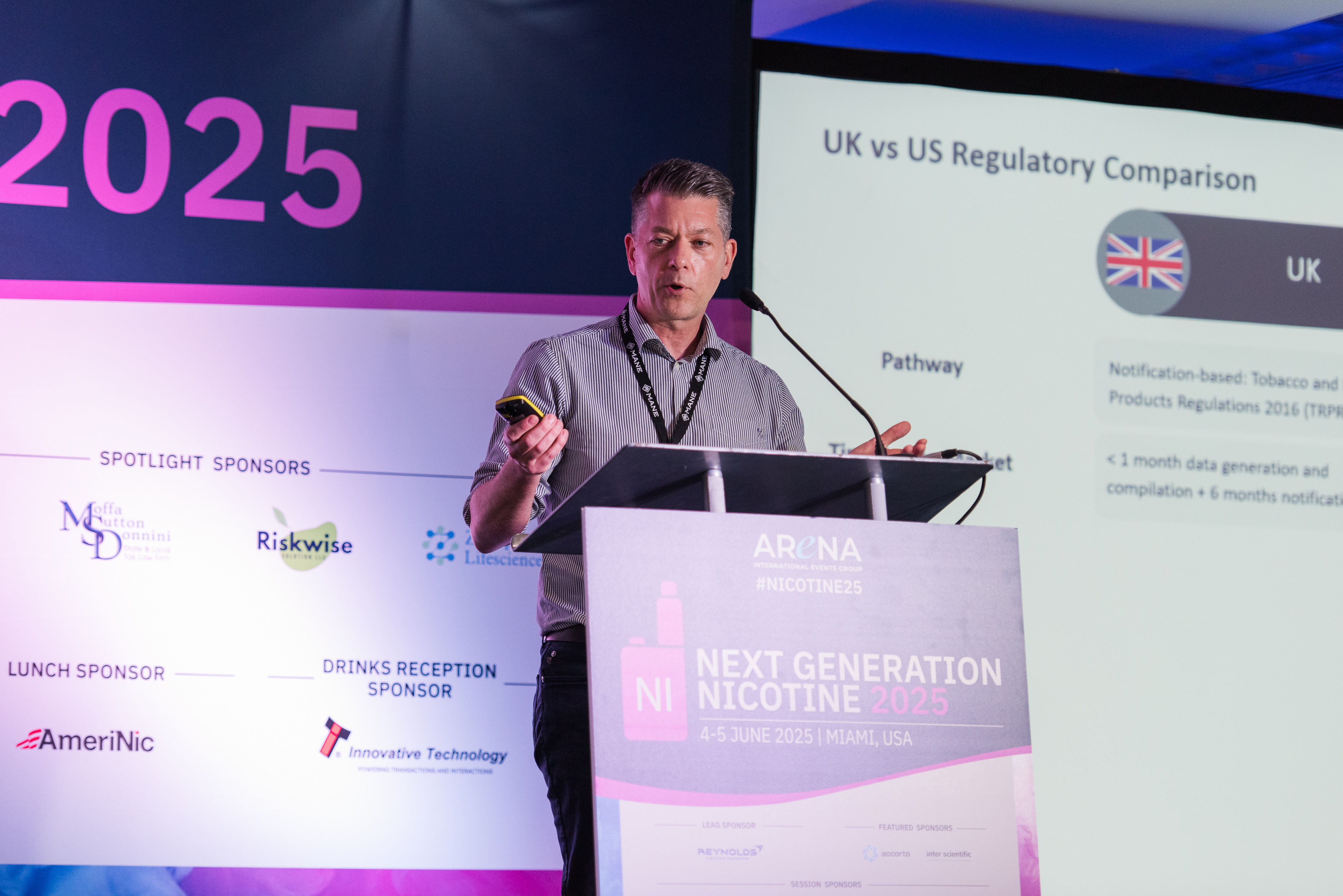
Chris Allen, CEO of UK-based scientific consultancy Broughton, told a tale of two regulatory regimes. Allen, whose firm has supported over half a million tests for premarket tobacco product application (PMTA) submissions to the U.S. Food and Drug Administration, pulled from real-world experience to illustrate how U.S. regulatory hurdles are stifling innovation and harming legitimate small businesses.
During a speech to nicotine industry stakeholders at the Next Generation Nicotine Delivery 2025 forum, held in Miami June 4-5, Allen urged regulators to provide a clearer, fairer path to market for reduced-risk nicotine products.
“We supported two companies who received marketing granted orders,” Allen said. “Another company spent more than $10 million over three years and still hasn’t received acceptance of filing. If they had known that at the start, they probably wouldn’t have done it. This is not conducive to fostering innovation and putting legal reduced-risk products in the hands of consumers.”
UK vs. U.S.: A Tale of Two Systems
Allen compared the UK and U.S. regulatory models, pointing out the stark differences in cost, complexity, and market impact. The UK system, which only requires notification and test-based toxicology, enables rapid product introduction. Over 40,000 products are registered in the UK. In contrast, fewer than 50 products have been authorized in the U.S. under the PMTA pathway.
“The UK notification process might cost a few hundred pounds. In the U.S., PMTA costs run into the millions,” he said. “Yet both countries face the same illicit market challenges and youth usage rates. So is the U.S. model delivering what it promises?”
One reason the illicit market thrives, Allen argued, is that consumer demand for convenient and long-lasting products is unmet by compliant offerings. In the UK, innovation has surged in response to a ban on disposables. Manufacturers have developed refillable “10+2” vape kits that comply with the letter of the law but offer the flexibility and puff count consumers want.
FDA Enforcement and the ‘Speeding Ticket’ Analogy
Allen drew laughs and nods from the audience with his analogy likening PMTA enforcement to speeding laws. “It’s illegal to speed, but most people assume they’re safe within 10 (miles) over the limit. The same rationale applies to companies selling in the U.S. without a marketing authorization. They think enforcement is unlikely, or that everyone else is doing it,” he said.
He noted that some companies genuinely misunderstand the law, often misled by advisors who claim products are legal under enforcement discretion. “The scariest one I hear is: ‘My regulatory advisor told me it’s legal,’” Allen said. “That should terrify all of us.”
Allen laid out what he sees as the necessary reform steps for the PMTA process: better guidance, transparent standards, clearer timelines, and swifter feedback from the FDA. “Right now, there is no carrot. Just a very big stick,” he said, showing a cartoon drawing of a tiny carrot being held at the back of the horse while a string with a stick attached was in front guiding the rider.
He emphasized the need for a system where companies can make informed ROI decisions based on a realistic understanding of costs and success rates.
Allen also warned that receiving a marketing order is only the beginning. Companies must maintain detailed change control, monitor manufacturing deviations, and report adverse events within 15 calendar days. “It’s like a mini-PMTA every year,” he said. “You have to keep proving your product is still appropriate for the protection of public health (APPH).”
He cited FDA marketing orders such as the one issued for Zyn, which require not only annual sales data but also robust surveillance plans, change logs, and ongoing toxicological assessments.
Allen used real-life pharma cases, including Ranbaxy Laboratories and Baxter International, to demonstrate how small changes in suppliers or production can lead to catastrophic consequences if not properly managed. “One supplier change led to 80 deaths,” he said. “Another case involved infant fatalities from contaminated glycerin and propylene glycol. This is serious.”
Illicit Markets, Tariffs and Global Shifts
Allen also briefly touched on geopolitical pressures such as tariffs, which are prompting more companies to consider moving manufacturing outside China. “Just changing your manufacturing site can have implications for product stability and quality. You have to factor all that into your regulatory reporting,” he warned.
Looking ahead, Allen suggested that the FDA could learn from its own past use of post-market surveillance. “We saw it with substantial equivalence. Perhaps lower-risk products could be approved under a post-market pathway as a way to relieve the current PMTA backlog,” he proposed.
Allen’s message was clear: a functional harm reduction marketplace needs regulatory clarity, fairness, and incentives for compliance. Without reform, companies committed to public health and doing things right will continue to face impossible odds, while others exploit gray areas.
“If you want to reduce the illicit market, meet consumer demand, and reward companies that are committed to science and safety, you need to fix the system,” Allen said. “The time is now.”