By Timothy S. Donahue
When James Xu surveys the global landscape of vaping and heated tobacco product manufacturing, he sees uncertainty more than opportunity.
“It’s a mixed bag,” says Xu, the founder of the once largest vape retailer in the United States, Avail Vapor. Xu is now developing his own vaping brand, Fav, that has no affiliation with Avail. “Some shops overseas are opening; others are shutting down,” he says. “Nobody knows what to do next.”
This air of volatility isn’t unique to Xu. Companies across the nicotine product supply chain—from hardware makers in Shenzhen to e-liquid firms in California—are grappling with a volatile combination of rising tariffs and tightening regulatory scrutiny. For years, Shenzhen, China, was the unquestioned hub of global vape production.
But now, with US import duties on Chinese vaping goods soaring to as high as 145% before recently dropping to 30% under a 90-day tariff pause, companies are being forced to make hard decisions. It’s just a short-term pause, according to Xu.
“You can’t make multi-million-dollar decisions based on a three-month window. That’s why most companies are sitting still,” Xu says. “Everybody thinks it’s not sustainable. Not for the US, not for China. It’s a lose-lose situation, but the US has more to lose overall.”
Despite the recent tariff relief, Xu sees no immediate end to the tension. “Even Trump and the secretary of commerce know it’s not sustainable,” he says. “But now it’s about saving face. Trump can’t walk it back without looking weak.”
A broken system
Xu is blunt in his assessment of the trade war’s impact. “It’s not sustainable—for either side,” he says. “It’s just stabbing each other.” He describes visiting US stores like Tractor Supply and seeing shelves partially empty. “Before you know it, we’ll have no medicine here, because all the raw ingredients come from China,” he says. “This whole thing is just crazy.”
Xu’s frustration is not limited to US policy. Chinese regulation has become increasingly burdensome for vape companies following the 2022 rollout of the Electronic Cigarette Management Measures (ECMM), which effectively banned domestic sales of flavored e-cigarettes. Under ECMM, e-cigarettes with flavors other than tobacco are banned for sale within China.
The new regulations have also imposed strict technical standards on ingredients, additives, nicotine levels, and safety testing protocols. While these measures were intended to address public health concerns and curb the burgeoning vaping market domestically, they have inadvertently accelerated the movement of manufacturers toward international markets.
That includes Ispire Technology Inc., which moved manufacturing of its vaping hardware to Malaysia, including its Sprout all-in-one cannabis vapor device. Pax Labs, another longtime industry player, relocated parts of its supply chain to Indonesia. “Companies started moving not because of tariffs, but because of the regulatory mess,” Xu says. “That’s why Pax and Ispire made their moves.”
Michael Wang, co-c.e.o. of Ispire Technology—a global company engaged in the research, development, design, commercialization, and distribution of branded vaping products—recalls the moment when the industry’s trajectory became irrevocably altered: “We came to the conclusion it doesn’t matter who is in the White House; the geopolitical train has left the station, and it will not come back.”
Today, while many of Pax Labs’ products are still produced in China, many of its flagship products, such as the Pax Plus and Pax Mini, are now produced in Malaysia.
KT&G, the South Korean company behind the lil Hybrid 3.0 heated tobacco device, shifted its production from Vietnam to Malaysia after abrupt policy changes halted operations in Hanoi late last year. A KT&G representative stated, “Due to supply issues caused by changes in Vietnamese policies, the problem is being quickly resolved [by moving production to Malaysia], and products have been restored to supply since the beginning of [May].”
While some companies have already moved parts of their operations to Indonesia and Malaysia, others remain hesitant. “Some companies set up in Indonesia but couldn’t keep it running. They ended up selling the facilities,” Xu notes. “It’s not always about tariffs. Sometimes, it’s just not feasible.”
Even Xu’s own vaping product is being manufactured with Chinese-produced components in Indonesia—not because of tariffs, he notes, but due to restrictions on shipping tobacco products into China. “It has nothing to do with tariffs. It is because of regulations, he says. “Our new product, Fav, contains tobacco [in the wicking]. And you can’t ship tobacco into China,” he explains. “So, we set up a small operation in Indonesia—final assembly only.”
That distinction is key. Xu says most of the operations moving to Southeast Asia are not full manufacturing facilities. Despite headlines suggesting an exodus from China, the reality is more nuanced.
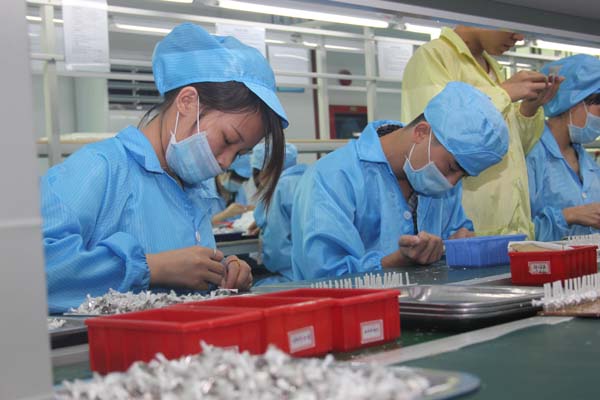
“When companies move to Indonesia or Malaysia, it’s really just final assembly,” Xu explains. “They don’t have the supply chain. Nowhere else has the ecosystem like Shenzhen. All the companies moving there are literally just slapping labels on boxes.”
The reason, Xu says, is that Southeast Asia also faces stiff tariffs—some as high as 46% on goods from countries like Vietnam [Malaysia is 24%]. “That doesn’t make it attractive to move there either,” he adds. “So, people are just waiting to see what happens next.”
The wait-and-see approach is pervasive. Xu owns another company with his sister, Ting, Evergreen Enterprises, which designs, manufactures, and distributes home and garden décor, gift items, and other products. Evergreen typically ships 2,000 containers from China to the US each year. Today? “We’re in a holding pattern. Nothing is shipping,” he says. “The shelves are going to look real empty soon.” (Ed: the conversation with Xu happened before the US-China tariff pause.)
The domino effect
Despite the uncertainty, the list of companies seeking refuge outside China continues to grow. Several manufacturers beyond Ispire and Pax have already established factories in Indonesia over the past few years, including Smoore (the world’s largest vaping product manufacturer), Mason Vape, Geekvape, and Jinjia.
The Trump administration has stated that manufacturers would be better served by moving their operations to the US. When asked if this was a feasible solution, Xu answered, probably not. “Many companies have tried to assemble consumables here, but it’s too expensive. And the (US Food and Drug Administration) FDA—well, it’s not enough to just have a (pre-market tobacco product application) PMTA,” he says. “There’s no incentive to invest millions when a new president could reverse the rules in a few years.”
Even infrastructure poses a problem. “The supply chain isn’t here,” he notes. “If you build a factory, you still have to import the parts from China, and then you’re back to dealing with tariffs.” Some ambitious efforts have already failed. Xu recounts a Chinese entrepreneur who tried to launch a Texas-based factory.
It was shut down by FDA for lacking proper approvals. Others attempted to do US-based e-liquid filling and assembly for Chinese firms, only to run into the same regulatory walls. “And even if you wanted to do it, the infrastructure isn’t here,” Xu says. “You’d have to import all the parts from China anyway, which puts you right back into the tariff trap.”
And China? Xu believes they’re better prepared to weather a prolonged standoff. “They’ve already found other sources for agriculture and semiconductors,” Xu explained. “It’s the US that buys everything from China.”
Like the recent changes in Vietnam, other Southeast Asian countries have also outright rejected any vaping company investments. Cambodian prime minister Hun Manet reiterated his government’s unwavering stance against e-cigarettes, emphasizing that the country will not entertain any investments related to their production, even if the products are intended exclusively for export.
“If it is any other type of investment, Cambodia is welcome, but when it comes to e-cigarettes, our stance is: ‘Not necessary, please look elsewhere’,” the prime minister stated in a press release. Cambodia has enforced a comprehensive ban on the import, sale, and use of e-cigarettes, heated tobacco products, and hookahs since 2014.
A double-edged sword
While Malaysia and Indonesia may offer short-term advantages, they come with their own challenges. Several Malaysian states—Johor, Terengganu, Kelantan, and Perlis—have banned the sale of e-cigarettes outright by refusing to issue retail licenses.
Others, including Penang and Selangor, are considering similar moves. And while federal law technically allows the sale of nicotine vapes, enforcement of Malaysia’s Control of Smoking Products for Public Health Act has been inconsistent. “It’s like a regulatory vacuum,” says Xu. “You move there thinking you’re safe, and suddenly you’re not.”
Indonesia, while more open, lacks a mature regulatory framework. Its low manufacturing costs and growing shipping infrastructure have drawn interest, but companies are still wary. “You’re not going there for long-term stability,” Xu adds. “It’s just a stopgap.”
The recent agreement between the US and China to lower tariffs for 90 days offers temporary relief—but little certainty. “Everyone thinks the tariffs will come down eventually,” Xu says. “This (current) deal is short-term pain relief, not a cure.”
It should be noted that many financial experts in the US have said that tariffs between China and the US could drop to 10% or even zero in 90 days.
For companies still rooted in China, the pressure is immense. Rising costs and regulatory crackdowns have squeezed margins and prompted fears of market share loss. For those moving abroad, the challenge becomes maintaining quality in unfamiliar environments. “Lots of companies are buying cheaper parts to cut costs,” Xu says. “But that risks consumer safety. And if something goes wrong, regulators will come down hard.”
Indeed, many companies now find themselves walking a tightrope: cut corners and risk their brand or absorb costs and risk bankruptcy. Some are betting on diversification—spreading production across multiple countries—but that brings new logistical headaches and compliance burdens.
For now, the vaping and heated tobacco products industry is stuck in a kind of geopolitical purgatory. The broader concern Xu shares is that if high tariffs continue for too long, behaviors will change permanently. “Once people shift supply chains, they don’t go back,” he says. “You change the flow of goods; you change the market forever.”
But even if the Trump administration were to reverse the policies, rebuilding isn’t easy. “Let’s say I build a factory in the US. It takes years. And what if the next president reverses everything again? I’m stuck with an expensive facility I don’t need,” Xu says. “That’s the reality in the US. Things swing back and forth too fast.”
In that sense, the 90-day tariff pause may not be the beginning of a reset—it might be just another delay in a long period of uncertainty. What’s clear is that the industry is evolving—geographically, financially and strategically. Companies that can adapt quickly, balance quality and cost, and manage regulatory complexity will survive. Others may not.
“We’re all in flux,” Xu says. “Nobody has the answer yet.” But they’re all looking.
But they’re all looking.