By Timothy S. Donahue
When the U.S. Food and Drug Administration issued its latest guidance on nicotine pouches, it delivered a clear and urgent message: child-resistant packaging is no longer a choice, it’s a necessity. The agency’s warning, backed by the threat of products failing the premarket tobacco product application (PMTA) process, underscores the immediate need for compliance.
The warning came at a time of increased scrutiny. Reports of nicotine poisoning among children have risen recently, fueled by the quick rise of flavored oral nicotine products. Regulators view child-resistant containers as a key safety measure. For brands seeking approval, packaging is now more than just marketing; it’s about survival.
Chubby Gorilla, the California-based packaging company with global operations, has a history of proactive innovation. Renowned for its forward-thinking e-liquid bottles that anticipated regulation years in advance, the company has now set its sights on nicotine pouches as the next big frontier.
“We were the only packaging company that had the testing completed when child-resistant packaging for e-liquids wasn’t even required yet,” said Abe Aboabdo, president and co-founder of Chubby Gorilla. “When the regulation came out in 2016, our customers didn’t have to scramble or pull products from shelves. Everyone else had to move fast—and most of them moved straight to us.”
From flow-restricted nozzles built to exceed the Consumer Product Safety Commission’s liquid-dispensing standards, to patented bottles that became the industry standard, Chubby Gorilla established its reputation by being proactive rather than reactive. Now, as the FDA focuses on nicotine pouches, the company is betting on its newest innovation, the X3 pouch container, to set the industry benchmark.
Engineering the X3
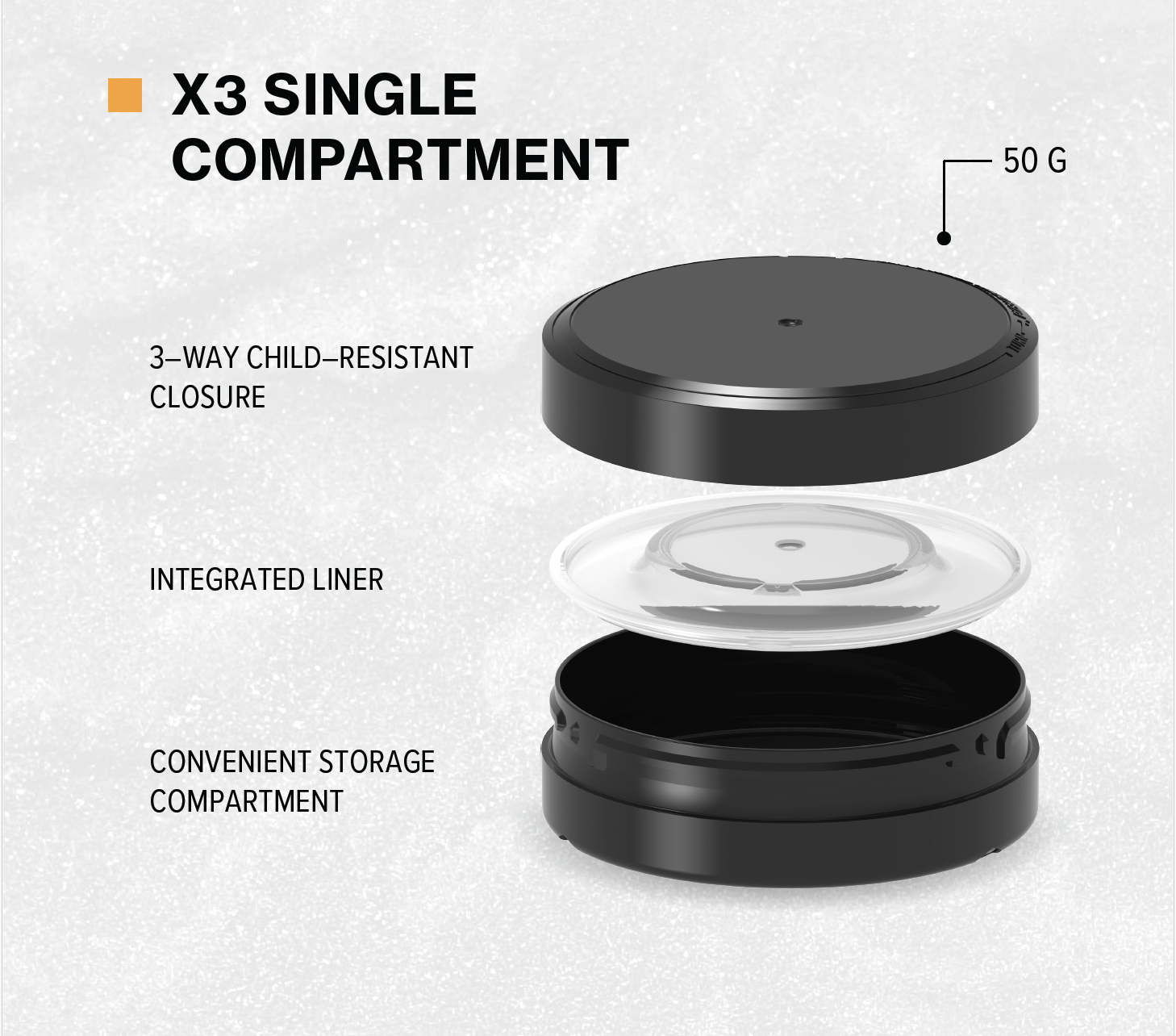
The X3 single-compartment pouch container, introduced in 2025, is marketed as the first of its kind to combine a user-friendly design with certified child resistance. At its core is a “three-way push-down-and-turn closure system,” which Aboabdo claims is far more practical than the “align-the-arrows” cans that dominate the market.

“Think about when you’re driving, or you’re in a dark room, or maybe you just have trouble with your vision,” he explained. “With most cans, you’ve got to line up the arrows perfectly to get it open. If you don’t, you’re pulling at the cap, and it pops off; the pouches go everywhere. With the X3, you just push down, turn a third of the way, and lift. It’s simple, fast, and familiar.”
The closure’s functionality is enhanced by an integrated liner made of polypropylene, which serves two purposes. “It helps maintain the internal environment—especially for wet pouches—and also functions as a spring to enhance the CR mechanism,” Aboabdo explained. The intentional tactile feedback, which is felt when the lid resists and then releases, was designed to make consumers feel the quality and attention to detail in the product. “We wanted consumers to feal it working,” he added.
Notably, the X3 not only met U.S. standards (16 CFR 1700.20) but also passed the Canadian CSA Z76.1:21 protocol and the ISO 8317 international CR testing standard, which is recognized throughout Europe. For manufacturers submitting PMTAs, that global compliance footprint provides added reassurance.
However, design was only half the equation. Manufacturers fear retooling costs—an obstacle Chubby Gorilla sought to eliminate.
“We made sure our measurements and capacity matched existing containers on the market,” Aboabdo said. “In most cases, you can drop the X3 right into your line. We recommend a small add-on for the closing process, which we provide free of charge and have our team install. No extra cost, no major downtime.”
In Chubby Gorilla’s experience, working closely with customers and even machinery vendors is part of the package. “We’ve always worked with the machine companies, always worked with clients to help make modifications or diagnose issues… we always help our clients with [that] investment as well,” Aboabdo says. And on the rare occasion when a production line requires more significant retooling, Chubby Gorilla pledges hands-on support to get things running smoothly.
That plug-and-play strategy is crucial in a market where changing packaging can lead to millions of dollars in production stoppages. By foreseeing operational challenges, Chubby Gorilla positioned the X3 not only as a safer choice but also as a smart business move.
Making the Switch
For pouch manufacturers, the X3 offers more than compliance. It supports a brand in standing out through safety, usability, and shelf appeal.

“Look, the market doesn’t really use child-resistant packaging right now,” Aboabdo said. “Kids are opening these containers, and poisonings are going up by 600 or 700 percent. Adults like the fruit flavors, that’s fine, but just like with medications, we need to stop kids from being able to get into these products”.
That combination—peace of mind for parents, convenience for consumers, and liability protection for brands—is the sales pitch. “You never want to be the company in the headlines for the wrong reasons,” he added.
The X3 is already gaining traction. Aboabdo confirmed that NYKD, a major nicotine pouch producer with U.S. distribution in Buc-ee’s and other retailers, has begun using the X3 container. The company quietly soft-launched the product internationally in 2025 and is now scaling up. Other brands are in talks with Chubby Gorilla, with customization options emerging as a key selling point.
“We stock black, white, and clear natural containers, but brands can go opaque, translucent, or fully clear. They can choose any Pantone color, mix and match closures and bodies, even add pearl finishes,” Aboabdo said. “It’s not just compliance—it’s brand identity on the shelf.”
Price, often the deciding factor, is positioned competitively. “Of course, CR packaging costs a little more, but we’re very competitive,” Aboabdo said. “For what we offer—the integrated liner, global compliance testing, child resistance—there’s nothing else like it at this price point.”
And unlike the click-can design some companies have flirted with, the X3 was built for function first. “Just because something has a certificate doesn’t mean it works well for consumers,” Aboabdo said. “If it’s frustrating or hard to use, people reject it. Our focus has always been making it both safe and intuitive.”
The Future of Pouch Packaging
For Chubby Gorilla, the X3 is just the beginning. Aboabdo hinted at future versions with dual compartments for used pouches and possible collaborations to include humidity-control packs. “It’s about functionality first, cost second, and making sure the consumer has a better experience than what’s out there now,” he said.

Expansion is already underway. The company operates in California, Texas, the Netherlands, China, and Thailand—a network designed to supply global pouch producers efficiently. “Wherever our customers are producing, we’re nearby,” Aboabdo said.
The timing couldn’t be better. Nicotine pouches are rapidly becoming one of the fastest-growing reduced-risk products, especially in the U.S. and Europe. Even Robert F. Kennedy Jr., the U.S. Secretary of Health and Human Services, made headlines this summer by calling pouches the “safest way to currently consume nicotine.” That endorsement, along with the FDA’s firm stance on packaging, paves the way for an industry shift in which child-resistant, user-friendly containers become the standard.
It’s a sentiment shared by the major tobacco companies that are investing heavily in oral nicotine. According to one estimate, U.S. nicotine pouch sales increased over 600% from 2019 to 2022, and global companies have invested billions in developing smoke-free products.
“Nicotine pouches are going to be the next big thing in nicotine delivery,” Aboabdo said. “The question is which brands are going to take packaging seriously enough to get ahead of the curve.”
As regulations tighten and consumers demand better experiences, the X3 stands as more than a packaging product. It’s a signal of how the nicotine industry must evolve: safer, smarter, and engineered with purpose.