By Timothy S. Donahue
Top Takeaways:
- South Korea will regulate synthetic nicotine pouches and e-cigarettes as tobacco products starting April 24, 2026.
- The law redefines tobacco from tobacco leaf to nicotine, closing a long-standing loophole.
- Packaging warnings, advertising bans, online sales bans, and smoke-free rules will apply.
South Korea will formally regulate synthetic nicotine products—including liquid e-cigarettes and nicotine pouches—as tobacco products starting April 24, 2026, following amendments to the Tobacco Business Act approved by the National Assembly, according to the Ministry of Health and Welfare and the Korea Health Promotion Institute.
The revision marks the first change to South Korea’s legal definition of tobacco since the law’s enactment in 1988, shifting the regulatory trigger from tobacco leaf use to the presence of nicotine itself. Under the amended definition, products containing nicotine—whether derived from tobacco or produced synthetically—will fall under the country’s tobacco control framework.
That change brings synthetic nicotine liquid e-cigarettes and nicotine-containing oral products, such as pouches, within the scope of tobacco regulation for the first time, closing a loophole that had allowed synthetic nicotine products to be marketed outside tobacco laws.
Health authorities said the decision follows several years of policy review and market monitoring. Since 2021, the government has held annual tobacco control forums and research initiatives with the Ministry of Health and Welfare, the Ministry of Food and Drug Safety, and the Korea Disease Control and Prevention Agency. Officials said studies identified carcinogens and other harmful substances in synthetic nicotine products, supporting regulatory expansion.
Once the amendments take effect, synthetic nicotine products will be subject to the National Health Promotion Act, including mandatory health warning images and text on packaging. Authorities said enforcement and compliance monitoring will be strengthened ahead of the 2026 start date.
Advertising restrictions will also be expanded. Tobacco advertising inside retail stores and in newspapers or magazines must prominently display health warnings at the bottom center of each advertisement. Broader promotional activity—including online advertising, external store displays, sponsorship of vape expos, and promotional events—will be prohibited, except in limited, designated areas within licensed retail outlets.
Online sales of nicotine products, including synthetic nicotine pouches and e-cigarettes, will also be banned under the revised framework, closing off e-commerce and social media distribution channels.
With synthetic nicotine products newly classified as tobacco, their use will be prohibited in smoke-free areas, including schools, hospitals, and government buildings. Violations will be subject to penalties under existing tobacco control enforcement mechanisms.
Flavor-based marketing targeting youth and young adults will face tighter scrutiny. Packaging or advertising that emphasizes fruit, dessert, or other youth-appealing flavors will be restricted, reflecting the government’s concern about rising youth uptake of non-combustible nicotine products.
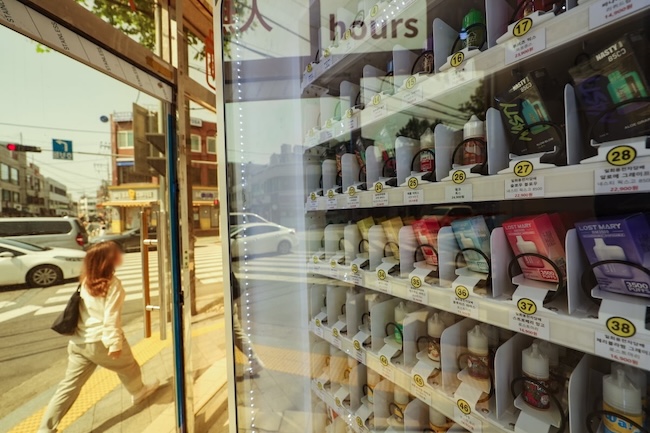
The amendments also tighten rules for unattended vending machines. Location restrictions and mandatory age-verification systems will apply, and vending machines that sell tobacco products—including synthetic nicotine items—will be progressively banned in educational protection zones starting February 2026, ahead of the broader regulatory rollout.
Officials said the revised law aims to align South Korea’s tobacco policy with evolving nicotine markets and eliminate regulatory inconsistencies that allowed synthetic nicotine products to evade oversight despite posing comparable health risks.