By Timothy S. Donahue
Top Takeaways
- Ban accelerates criminal takeover: Mexico’s near-total vape ban is consolidating sales under organized crime groups.
- Retail exits, illicit supply expands: Legal shops are shutting down as cartels move into sourcing, branding, and distribution.
- Australia parallel emerges: Like Australia, Mexico is seeing demand shift from regulated channels, increasing crime risks without eliminating use.
Mexico’s sweeping ban on e-cigarettes is rapidly reshaping the country’s vaping market. Organized crime groups are tightening their grip on vape sales, which were already drifting toward the underground market before the prohibition formally took effect.
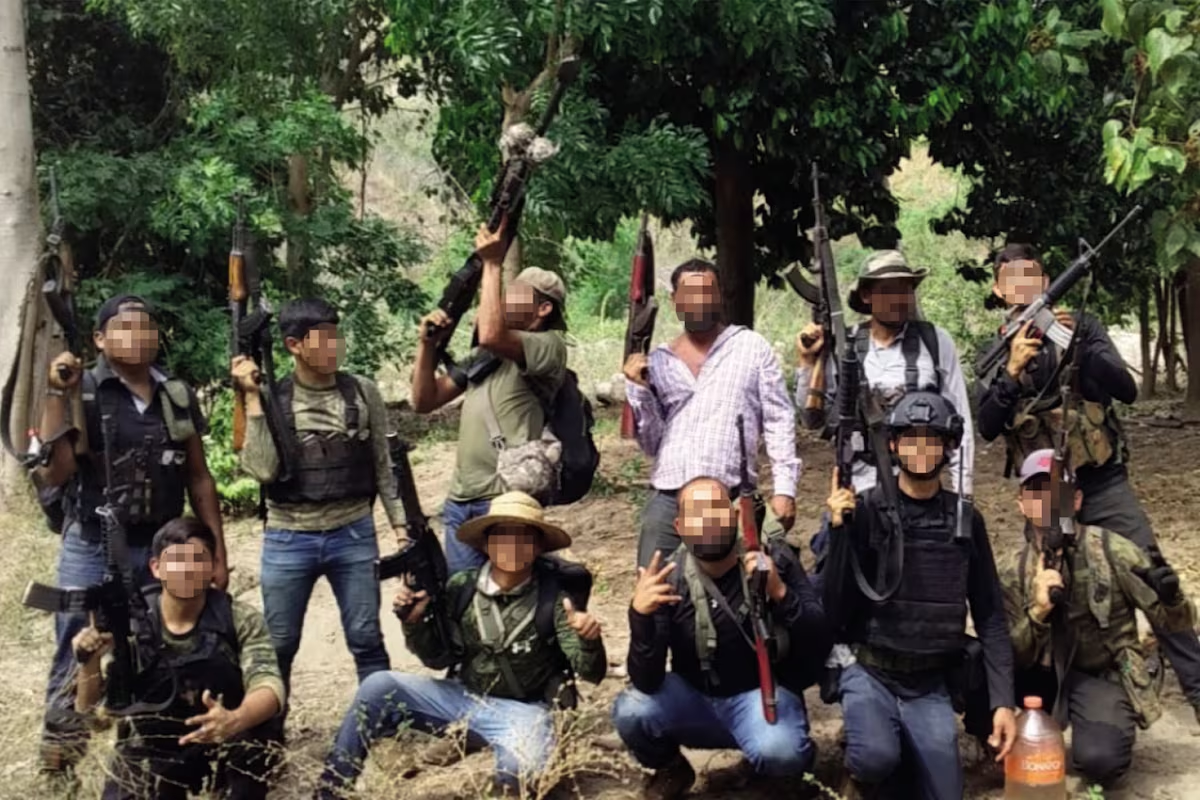
In northern Mexico, cartel involvement in the vape trade predates the ban. One former vape shop owner, now living in the United States, told reporters that cartel members seized his business in early 2022, abducting employees and telling management the store could operate only under cartel control and primarily online.
“They don’t come asking whether you want to give them your business,” the former owner said. “They come telling you what’s about to happen.”
At the time, vaping was still legal in Mexico, and the market was estimated to be worth roughly US$1.5 billion annually. That changed this month, when Mexico implemented a near-total ban on the manufacture, sale, import, transport, and distribution of e-cigarettes, while stopping short of criminalizing personal use. The report was first published by the AP and authored by María Verza.
Policy experts and industry lawyers say the ban has accelerated the transfer of market control from regulated retailers to criminal organizations. Zara Snapp, director of the Mexico-based Ría Institute, said outlawing the products effectively hands the market to non-state actors in a country already grappling with corruption and cartel violence.
Alejandro Rosario, a lawyer representing vape retailers, said criminal groups have increasingly positioned themselves as suppliers, often promising protection from enforcement in exchange for compliance.
Mexico’s path to prohibition has been uneven. Former President Andrés Manuel López Obrador initially banned vape imports and sales by executive order, but the Supreme Court later ruled the measure unconstitutional.

His successor, President Claudia Sheinbaum, secured passage of a constitutional amendment in January 2025 that explicitly classified e-cigarettes alongside illicit drugs such as fentanyl.
While the amendment laid the legal groundwork for prohibition, implementing legislation did not close enforcement loopholes that had allowed vapes to continue entering the country from China and the United States until December.
Under the new law, penalties for violations can include prison terms of up to eight years. Mexico City retailer Aldo Martínez said he immediately stopped selling vapes, which had accounted for roughly two-thirds of his income.
“I don’t want to go to jail,” he said. Others expressed concern that vague definitions of personal possession could enable corrupt enforcement or extortion, even where use remains legal.
As legal retail channels disappear, organized crime groups are expanding their role. According to Rosario, some cartels now brand their own vape products, while others buy disposable device shells directly from Asian manufacturers and fill them locally. A report by the Mexican watchdog group Defensorxs identified the Jalisco New Generation Cartel and other criminal organizations as active in repackaging and distributing illicit vapes in major cities.
The Mexican experience mirrors patterns observed elsewhere when outright bans clash with persistent consumer demand. In Australia, where high tobacco excise taxes and strict vaping restrictions have coincided with a surge in illicit tobacco and vape sales, law enforcement and retailers have warned that prohibition has fueled organized crime, violent competition, and widespread black-market retailing rather than eliminating consumption.
Australian authorities said they have now linked at least 200 firebomb attacks and several deaths to what the Australian Criminal Intelligence Commission (ACIC) openly calls the “tobacco wars,” a turf fight fueled by organized crime groups profiting from the sales of illegal nicotine products.
In Queensland, a single raid uncovered 30 million cigarettes, nearly 400,000 vapes, and 4.65 tons of tobacco — with duty evasion estimated at over AU$53.8 million.
In both countries, the underlying dynamics are similar: legal access narrows, demand persists, and criminal networks step in to fill the gap—often with fewer safety controls, no age verification, and increasing risks for retailers, consumers, and public authorities alike.