By Timothy S. Donahue
Top Takeaways:
- Robust Consumer Research is Crucial for Success in Next-Gen Nicotine Markets: Dr. Jessica Zdinak emphasized the importance of pre-market research—such as needs assessments and feasibility studies—to avoid costly missteps in product development and regulatory filings.
- FDA Still Relies on Legacy Review Culture Despite Leadership Changes: Although CTP has seen leadership turnover, Zdinak cautioned that “the core scientists reviewing applications haven’t changed,” signaling a continued reliance on rigid internal standards developed under prior administrations.
- Integrating Behavioral and Clinical Science Strengthens PMTA Success Rates: ARAC’s new approach blends clinical biomarkers with behavioral data in Module 6 studies, helping manufacturers better demonstrate population-level benefit and reduce bias in self-reported outcomes.
In an era of increasing regulatory pressure and market fragmentation, one of the most powerful tools for success in the nicotine industry is neither flashy branding nor sheer investment—it’s deep, science-driven consumer understanding.
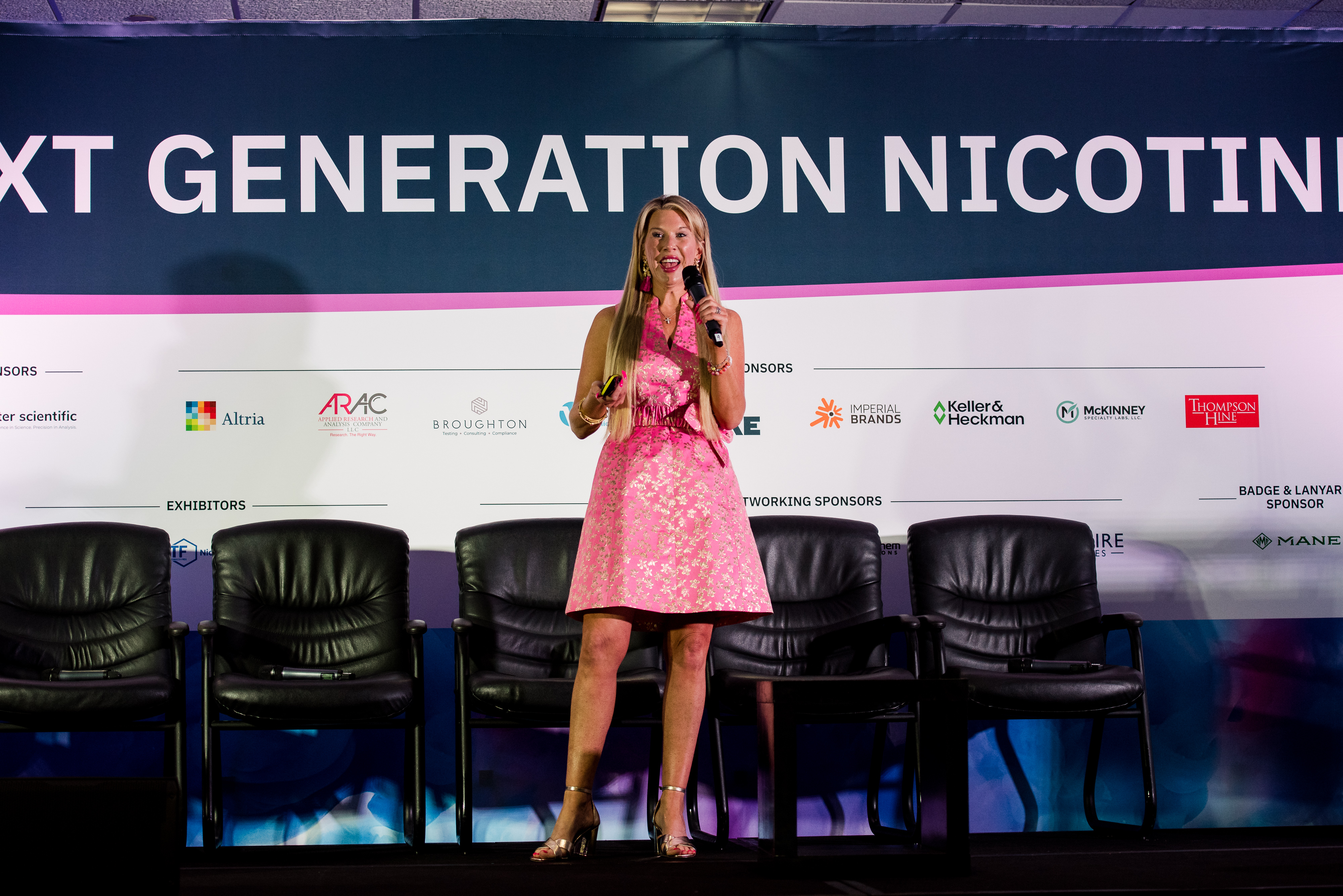
That was the central message from Dr. Jessica Zdinak, Founder, Chief Research Officer and CEO of Applied Research and Analysis Company (ARAC), during her presentation, Bridging the Gap between PMTA Module 5 & 6 Regulatory Expectations and Business Objectives, at the Next Generation Nicotine 2025 forum in Miami (June 4-5).
“Behind every quantitative data point, there is a human story,” Zdinak told the audience of nicotine industry stakeholders. “You can’t expect to succeed in this space if you’re not rigorously exploring your consumer’s perceptions, values, lived experiences, and future behaviors.”
Her firm, ARAC, specializes in bridging product development, regulatory strategy, and real-world market performance through the lens of behavioral science. With over a decade of experience in the nicotine and tobacco field—and a combined 50 years of expertise across her team—Zdinak’s approach reflects a hybrid of academic rigor and commercial practicality.
Avoiding the ‘Jawbreaker’ Mistake
Zdinak illustrated the stakes with a cautionary tale she called “The Jawbreaker Scenario,” a composite example based on real-world industry missteps. A fictional company, “Miami Vice,” attempts to break into the oral nicotine market with a candy-like nicotine product it brands as “Jawbreaker.” The product launches in Sweden but flops, and the company halts its U.S. (premarket tobacco product application)PMTA efforts and cancels a pending Italian launch.
“This scenario cost them hundreds of thousands of dollars,” she said. “But what if they had done even a small-scale needs assessment? A feasibility study? They would have known the product wouldn’t resonate with Swedish consumers and could have redirected to the U.S. market, where it did.”
Instead, Zdinak argued, rapid and iterative consumer feedback—grounded in behavioral science—is essential for not just meeting regulatory hurdles but avoiding costly commercial failures.
Hard vs. Soft Science: Why Both Matter
Much of Zdinak’s presentation centered on Modules 5 and 6 of the U.S. Food and Drug Administration’s PMTA process—respectively focused on individual health risks and population-level impact. While many companies pour their resources into toxicology and product chemistry, she warned against downplaying the behavioral component of regulatory science.
“There’s this false divide between ‘hard science’ and ‘soft science,’” Zdinak said. “But Module 6— for example, risk perceptions, appeal, likelihood of misuse, intention to switch—is not subjective. It’s measurable, and it’s critical.”
To improve the reliability of behavioral data, ARAC has begun integrating biomarkers into some of their studies to validate self-reported outcomes. “We’ve combined clinical and behavioral assessments in a way that reduces bias and enhances credibility with FDA reviewers,” she said.
This interdisciplinary model has also allowed ARAC to consolidate data requirements across Modules 5 and 6, shortening timelines and reducing costs for clients. “If you do it right, you don’t need to conduct two separate, massive studies,” she said.
Understanding the Human Layer
Zdinak pushed back on overly narrow approaches to behavioral research. “You can’t just ask someone, ‘Would you switch to this product?’ and take the answer at face value,” she said. “You have to talk about real-life scenarios—losing a job, going through a divorce—and understand how those events shape their behavior.”
She also emphasized the need for cultural competency in global research, citing ARAC’s partnerships across international markets. “You have to become the person you’re studying. Otherwise, you’ll miss what matters,” she said.
A visual she shared—a psychological iceberg—captured the principle: above the surface are observable behaviors, but underneath are the beliefs, experiences, and emotions that truly drive consumer decisions. “If you’re not exploring what’s under the surface, your data is incomplete,” she said.
Regulatory Landscape: Uncertain, but Navigable
Zdinak acknowledged how some of ARAC’s clients see “chaos” within FDA’s Center for Tobacco Products (CTP) and a perceived lack of strategic clarity following recent leadership shakeups. However, she advised companies not to misread the moment.
“Despite the turnover, the core scientists at CTP reviewing your applications haven’t changed,” she said. “That means the criteria—what they look for—haven’t either.”
She noted that ARAC has maintained productive, science-based dialogues with FDA staff. “They’re still very much emphasizing robust, reliable, and generalizable data,” she said. “They want to know: how will this product benefit population-level public health?”
Zdinak also cautioned that recent enforcement upticks, especially at ports of entry, reflect an increasingly serious tone from regulators. “State-level flavor bans, like California’s, now carry real legal consequences,” she said. “If you’re marketing a flavored e-liquid and you don’t have the data to show it’s not a characterizing flavor, you’re in illegal territory.”
She also said that her team is working to assess whether flavors are viewed by consumers as “characterizing” based on “core sensory product research standards and methodologies.”
Creating Predictive Risk Models
Zdinak closed with a preview of ARAC’s upcoming work on quantitative models that assess the “appropriate for the protection of public health” (APPH) standard using predictive equations. These models integrate factors such as product type, nicotine content, number of flavors, misuse risk, and youth initiation potential.
“You plug your own product data into the model, and it provides a directional assessment,” she said. “It won’t replace FDA’s determination, but it will help you understand where you stand.”
This approach, she argued, can help companies align their product development, marketing, and regulatory strategies around one central question: “Is this product likely to deliver more public health benefit than risk?”