By Timothy S. Donahue
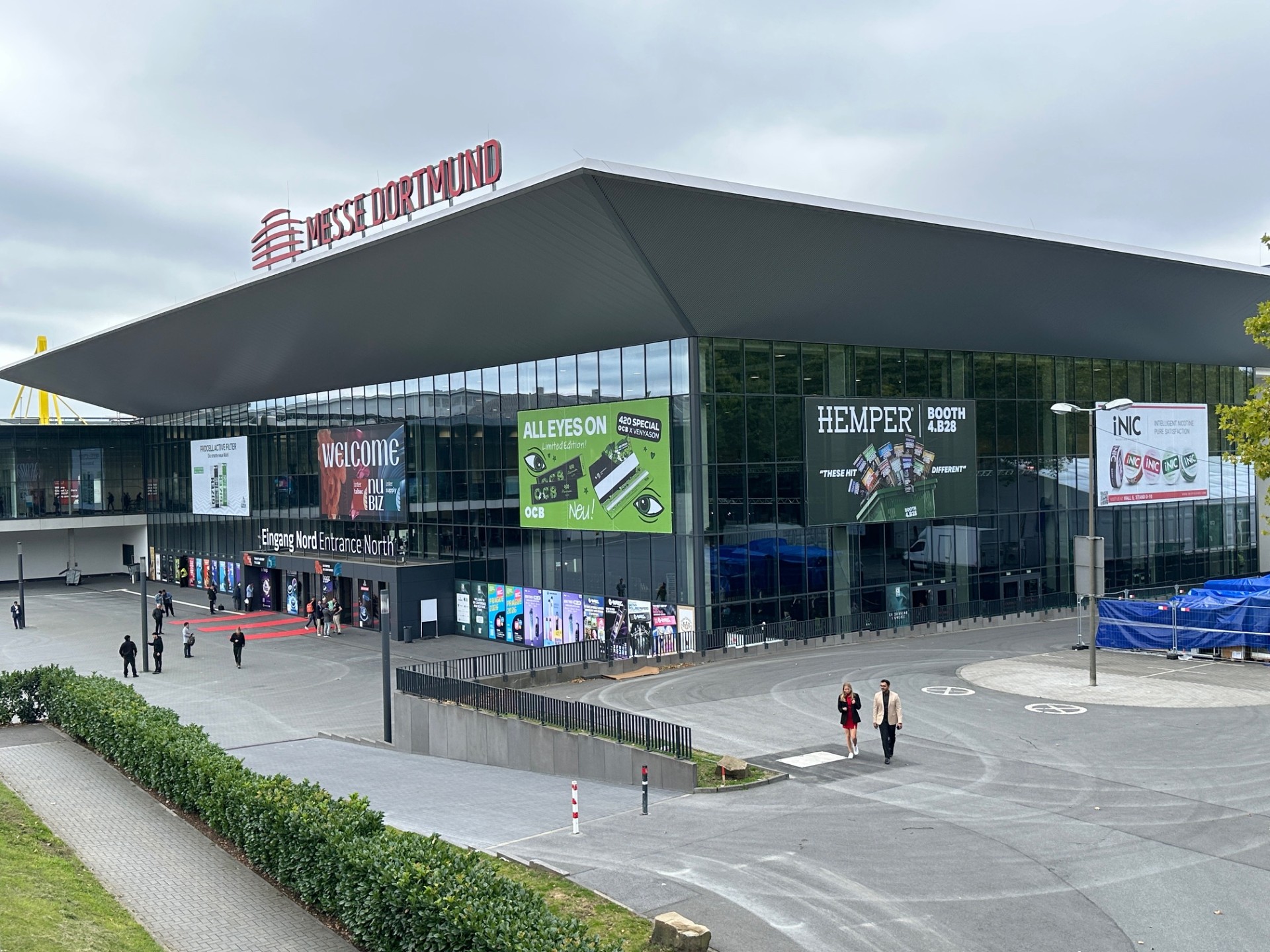
During the dual InterTabac /InterSupply 2025 trade show, the halls of Messe Dortmund were filled with the energy of attendees from the tobacco and nicotine industries, as well as representatives from the cannabis and wellness segments. More than 800 exhibitors and representatives from approximately 70 countries visited or exhibited at the show, according to a recently released report from Wingle Group Electronics. Additionally, an estimated 90 percent of exhibitors and attendees plan to return in 2026.
Sabine Loos, managing director of Westfalenhallen Group, which owns both the InterTabac/InterSupply trade fairs and the Messe Dortmund venue, emphasized the growing international presence. “We’ve succeeded in creating an environment for inspiration, knowledge, deal-making, and networking in a fast-paced, diverse industry,” she said.
The presence of new product categories near existing segments reinforced the show’s role as a global gathering place for both established and emerging innovations, according to a report by the Wingle Electronics Group on the event. Maryna Gudym, business development manager at Wingle, and her team helped identify many of the trends in traditional tobacco products, heated tobacco products, the oral evolution, and package compliance discussed below.
Hardware Evolution
Hybrid heating systems dominated the hardware discussion. Exhibitors showcased multi-mode devices capable of switching between e-liquid, heat-not-burn (HnB), or combined HnB and liquid modes. many of the advanced hardware products featured AI-driven calibration to adjust power delivery based on ambient temperature, draw style, and battery status.

FirstUnion’s Biheat line, for example, combines conduction and convection heating with embedded sensors and learning algorithms. The company claims the device adjusts its power curve in real time to maintain flavor consistency. Shenzhen Yunxi’s Uwoo Dual similarly offers dynamic mode switching between aerosol and hybrid modes.
Multiple modular platforms attracted attention. Device frames that accept different pods—liquid-only, leaf-only, or hybrid—were showcased by companies like Thermix, Rejo (with its Multi device compatible with Iluma, REJO, and CNTC sticks), and Voopoo (utilizing an adaptable chipset architecture). These systems enable brands to shift focus as regulations and consumer preferences evolve quickly.
Clear pod visibility was almost universal. Aspire drew attention with its Cyber G Slim and Nexi Pro models, which highlighted aesthetics and transparent liquid levels. Kevin, a vapor hardware designer, noted that over 30 major brands at the show featured clear-pod version, including the Geekvape Clio X, Nexa Flex, iJoy XP50000, Movkin Curved 50000, Lost Angel Mate 50K, and many others.
Other device improvements included adjustable cooling (as seen on Mr. Fog’s Switch), flavor mixing (Flum’s Utbar 50000 offering combinations of up to seven flavor elements), and twist-to-extend battery systems. In-booth demos, adjustable airflow, dual-heater section control, and haptic feedback were common features that distinguished one product from another.
Companies also appeared to continue focusing on durability, moving away from complex systems and towards smaller, independent, and interchangeable functional units. Exhibitors like Yihui showcased serviceable heating modules that enable consumers to replace the coil pack while keeping the main shell intact. Others emphasized the use of hermetically sealed heater cores to prevent corrosion in humid markets.
Beyond the Pouch
While pouches remain popular, InterTabac 2025 demonstrated that manufacturers are branching out beyond traditional formats.

RELX unveiled its AirPouch, a wafer-thin pouch designed for high nicotine delivery in a nearly invisible format. Huabao introduced a three-layer dissolvable strip combining base, buffer, and nicotine salt layers to allow controlled release. Jobayo (Hancheng) previewed micro-granule prefilled pouches for ultra-compact packaging.
Hybrid oral/film designs also appeared. Some developers combined sublingual films with pouch shells—consumers insert a film into a base pouch for dual-route absorption. Other brands featured capsule-embedded pouches that open under pressure for a burst release.
Innovation extended to functional and/or multi-active oral products. Caffeine bursts, botanical boosters, or stimulant blends (e.g. taurine, L-theanine) were embedded into portions marketed as “performance pouches.” Some strains promised focus or calming effects beyond nicotine.
Packaging for oral nicotine products also had several innovative breakthroughs exhibited during InterTabac. Chubby Gorilla introduced a dual-compartment, child-resistant can, enabling users to preload two flavors, as well as the new X3, which features an innovative child-resistant opening system. Origin Pharma’s ClicCan system utilized a push-to-open locking lid to meet stringent regulatory standards. Finest Global expanded its Pop ’n Go line with a one-hand lid design optimized for retail shelf placement.

Developers also introduced high-nicotine micro-pouches for markets with product restrictions, along with ultra-mini formats for trial packs. Several booths displayed new blister card wrappers and tamper-evident seals designed to extend shelf life in various climates.
Cannabis Crossover
An increasing number of cannabis and wellness exhibitors took part in the CB Expo segment, showing how vaping hardware is spreading across different categories.
The Folar Penta vaporizer features a dual-mode pod system compatible with both nicotine and botanical oils. The comany claims the device offers “residue-free switching.” Another cool cannabis product was showcased by Curaleaf, a CE-certified medical vaporizer co-developed by Jupiter Research for controlled-dose cannabis inhalation.
Jwell SAS gained attention for a “Smarter Duo” device that can switch between nicotine cartridges and cannabis juice pods with the flip of a module. Eden Labs and Orion Devices showcased universal pod hardware capable of handling multiple chemistries—nicotine, CBD, terpenes, or other botanicals.
Wellness products also gained popularity. Nanyang Brothers introduced La Yuva, an ultrasonic nebulizer that delivers botanicals like ginseng, chamomile, and adaptogens. The device calls itself “functional inhalation,” offering a crossover for users who want inhaled botanicals alongside nicotine.
Vendors and analysts have noticed that the boundaries between nicotine, cannabis, and functional inhalables are quickly becoming less clear. Many innovators aim for their hardware to integrate these sectors, improving R&D efficiency and reducing product development costs.
Regulatory Winds & Market Pressure
Regulation and enforcement scenarios emerged throughout the show, both literally on the show floor and more figuratively during the event’s program sessions. Messe Dortmund reported that German customs officers intercepted untaxed e-cigarettes at booths, highlighting the real-time compliance risk for exhibitors. It’s become a yearly occurrence.

A breakout seminar during the show, titled “Eyes on Brussels,” featured experts examining the impact of Europe’s Tobacco Products Directive (TPD) revision, changes to the excise directive, cross-border compliance, and oversight at the World Health Organization’s upcoming COP11.
On the panel, a representative from the European Commission highlighted that deviations at the national level must not fracture the internal market. A Verband des E-Zigarettenhandels (VdeH), the German e-cigarette trade association, representative issued strong warnings about flavor bans and heavy taxation, stating that these measures would suffocate the legal market and strengthen the black market. A German tobacco-free advocacy group spokesperson added that excessive taxation could destroy emerging nicotine pouch businesses. Retail-facing voices were also present. Peter Schweinschwaller, president of the CEDT (European Confederation of Tobacconists), discussed how retailers need to adapt inventory, training, and risk mitigation as product mixes evolve.
Bodo Mehrlein, CEO of the German Cigar Manufacturers’ Association, told media that cigar exhibitors maintained their traditional booth count, and while the nicotine landscape is shifting, traditional tobacco, especially premium cigars, remain relevant. However, he also noted that the show’s emphasis on smoke-free formats is prompting the traditional tobacco companies to reassess their portfolio strategy.
During the Awards evening, the World Alternative Awards—a collaboration between Messe Dortmund and Alternative magazine—honored select exhibitors across various categories. Hybrid devices, oral innovations, and packaging breakthroughs took center stage, underlining where industry attention is gravitating.
Closing notes
InterTabac 2025 affirmed that the nicotine industry is in the midst of a structural inflection. The road ahead for vaping hardware is not about pushing more power—it’s about smarter control, adaptive systems, and modular versatility.
Oral nicotine products are no longer limited to pouches. The segment is evolving into a variety of multi-active, multi-format systems. Packaging is becoming a design frontier. And crossover inhalables tied to wellness or cannabis signal a broader domain challenge for regulatory and market definitions. Regulatory friction is pervasive. Customs seizures, tax uncertainty, flavor restrictions, and divergence across national laws globally means that compliance must be designed in, not bolted on.
As for next year’s show, one structural change was announced. Messe Dortmund told the media that InterTabac and InterSupply 2026 will take place on a Tuesday–Thursday schedule (15–17 September), instead of its traditional Thursday-Saturday timeframe. The change is an attempt by show organizers to facilitate more straightforward navigation of international logistics and travel for exhibitors and attendees. The change may also enable attendees to engage more effectively with the various show segments, particularly the emerging market halls, as many will now be able to stay for the entire duration of the show.
The clear message from Dortmund is that the next frontier in nicotine won’t be incremental. It will be hybrid, smart, regulated, and cross-disciplinary. Those companies and brands that plan ahead—not just rely on raw innovation—are likely to lead the way.