By Timothy S. Donahue
Top Takeaways:
- MOP4 emphasized prosecution, data-sharing, and cross-border enforcement—without addressing industry concerns about accuracy of illicit-trade claims.
- WHO FCTC officials again accused the tobacco and nicotine sectors of “fueling” illicit trade, but independent investigations show mixed evidence and broader drivers.
- COP11 closed with Parties considering sweeping nicotine prohibitions and approving a full ban on all nicotine products across all UN premises.
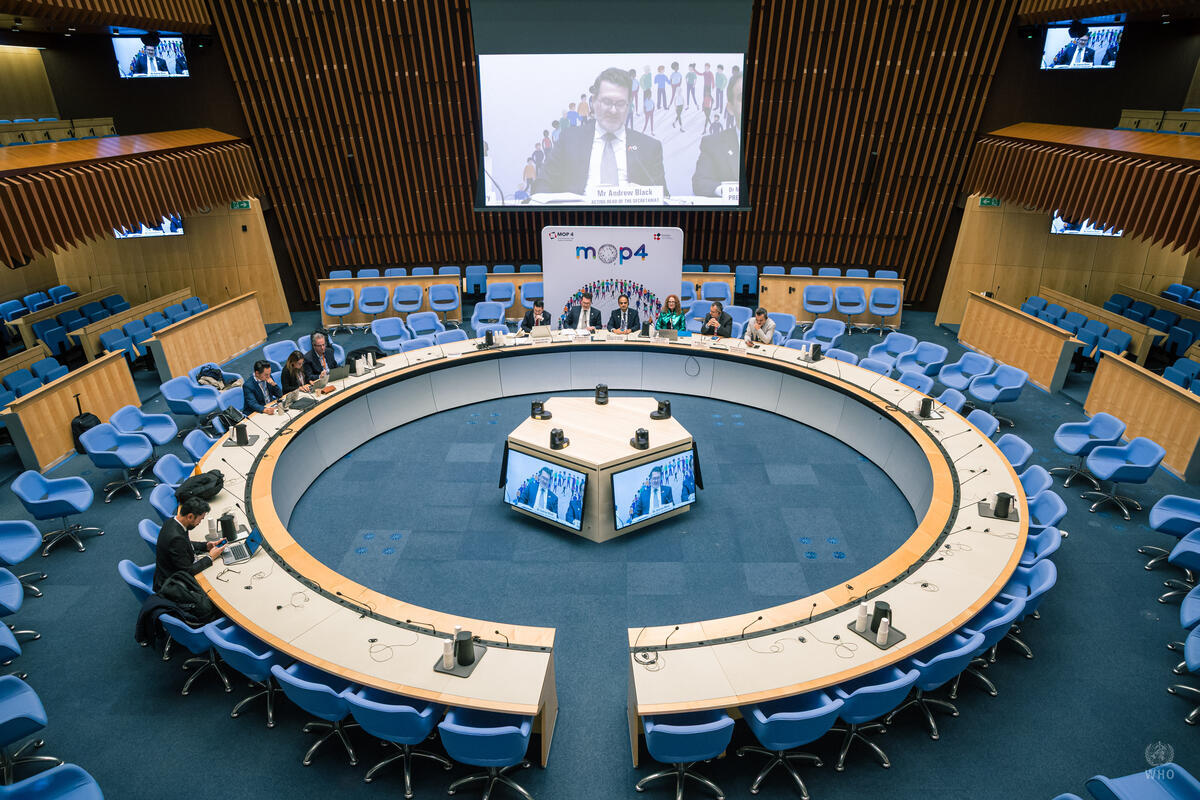
The Fourth Meeting of the Parties (MOP4) to the Protocol to Eliminate Illicit Trade in Tobacco Products concluded in Geneva, with officials from the World Health Organization Framework Convention on Tobacco Control (FCTC) urging greater criminal justice involvement, expanded enforcement coordination, and stricter operational controls over the tobacco and nicotine supply chain.
During the official closing briefing, Secretariat leaders described illicit tobacco as a global threat to public health and tax systems, emphasizing that governments must increase prosecution efforts and cross-border investigations.
Andrew Black, acting head of the WHO FCTC Secretariat, opened the briefing by calling illicit trade “not a victimless crime,” claiming it fuels money laundering, corruption, and organized crime while costing governments tax revenue. He reiterated the Secretariat’s estimate that eliminating illicit tobacco could recover more than US$47 billion annually worldwide.
Independent economists note that such global estimates vary with assumptions about baseline volumes and enforcement effectiveness and do not account for shifting consumer behavior or the dynamics of unregulated nicotine markets.
Black highlighted new decisions made at MOP4, including the formation of a Working Group on Article 6.5 to review controls on key manufacturing inputs, a Working Group on Article 24 focused on assistance and cooperation, and a mandate for the Secretariat, United Nations Office on Drugs and Crime (UNODC), and the World Customs Organization (WCO) to map global seizure data to aid in standardizing enforcement approaches.
Parties also adopted guidance encouraging greater collection of licensing fees to help fund monitoring and enforcement efforts. During the briefing, Black announced that the island nation of Vanuatu had joined the protocol, bringing the total membership to 71 Parties.
MOP President Dr. Mansour Zafer Al Kathiri stated that over 800 delegates participated and highlighted that 80 percent of Parties reported adherence to Article 5.3—WHO FCTC rules limiting industry engagement. He called MOP4 a chance for Parties “to recommit themselves to eliminating illicit trade,” mentioning decisions on licensing, seizure information sharing, prosecution, and inputs to manufacturing.
He expressed gratitude to observers and non-Party states for attending and was optimistic that more countries would join.
Throughout the week, WHO FCTC speakers described illicit trade as becoming more sophisticated and closely linked with organized crime. However, journalists questioned the Secretariat about whether this portrayal matches regional enforcement realities, considering that many illicit market studies show significant variation based on border openness, tax differences, and local enforcement capability.
Black argued that the increase in global cigarette seizures indicates improved detection rather than a growth in illicit markets, a point some analysts challenge because seizure data does not necessarily reflect actual consumption.
Global Enforcement Pressure
The high-level MOP4 session brought together cross-border enforcement agencies, prosecutors, researchers, and investigative journalists for discussion.
Interpol’s Director of Strategic Partnerships, Dr. Ying Wu, told attendees that illicit tobacco is increasingly connected to broader “poly-crime” operations—such as drug trafficking, counterfeit pharmaceuticals, money laundering, and corruption—and that criminal groups easily shift between commodities using the same routes, logistics, and secretive supply chains.
She warned that enforcement gaps, under-regulated free-trade zones, and jurisdictional blind spots enable illegal flows to flourish. Interpol highlighted operations in South America and international efforts like Operation Pangea, which recently confiscated contaminated counterfeit vaping products circulating through online sellers and cross-border courier networks.
Prosecutors from Gabon and Latvia described national challenges rooted in porous borders, corruption, resource limitations, and the difficulty of proving individual criminal intent in smuggling cases. Gabonese prosecutor Perrine Ada Obiang detailed the reliance on unofficial river crossings, minimal scanning capacity, and complex supply chains originating in Cameroon and Nigeria.
Latvian prosecutor Lakita Sinkiewicz highlighted cases involving hidden compartments in semi-trailers and emphasized that many illegal trade prosecutions in Europe are increasingly related to electronic smoking devices, which Latvia bans from online sales to prevent unregulated imports targeting minors. She pointed out that many illegal vaping product sellers operate from abroad, making enforcement more difficult.
Civil-society organizations and investigative journalists raised broader structural critiques of global enforcement. Andrei Ciurcanu of the Organized Crime and Corruption Reporting Project (OCCRP) said investigators “often find smugglers and companies working hand in hand,” but only in environments where authorities are corrupt or overwhelmed.
He argued that many agencies “do not see the big picture,” focusing on individual seizures without understanding transnational networks. OCCRP reporting has documented cases where illicit flows exploited weak data sharing between countries, fragmented investigations, and failures to thoroughly examine corporate devices or communications.
OCCRP editor Alessia Cerantola said journalists’ cross-border networks have uncovered situations where illicit cigarette volumes were allegedly used by companies to pressure governments to lower excise taxes—a tactic meant to portray tax shocks as the cause of illegal trade, even in markets where independent data shows that organized crime and regulatory gaps are more significant drivers.
She noted that some brands have appeared in illegal channels before being officially registered with customs, raising questions about the relationship between supply-chain diversion and regulatory approval processes, although no proof was offered. She also pointed to cases in which ministries of health or customs authorities delayed or suppressed reports on illegal trade patterns, highlighting internal political tensions.
Tuesday Reitano of the Global Initiative Against Transnational Organized Crime said that illicit tobacco should be prioritized within organized crime strategies rather than relegated to secondary fiscal concerns. She argued that crime groups operate most effectively in areas with weak beneficial-ownership rules, free-trade zones with limited oversight, and under-regulated corporate-registration systems.
She urged Parties to harmonize penalties across jurisdictions, warning that criminal networks “always migrate to the path of least resistance.”
During the final press conference, Secretariat officials emphasized that the protocol already includes “sustainability mechanisms,” such as licensing fees and manufacturer-funded track-and-trace systems. However, several countries informally remarked that advanced enforcement systems remain expensive and technically challenging.
The Secretariat replied that implementing the protocol should be seen as “an investment,” reiterating earlier comments about tax-revenue benefits. Independent studies, however, consistently show that tax recovery varies greatly depending on governance effectiveness, border security, and the extent of illicit manufacturing.
What Comes Next
MOP4 took place one week after COP11 concluded in Geneva and pushed forward some of the most significant positions in treaty history. Parties discussed future-oriented “endgame” measures under Article 2.1, including proposals to fully ban nicotine products. COP11 also approved a binding decision to ban the use and sale of all tobacco products, heated tobacco products, electronic nicotine delivery systems, and electronic non-nicotine delivery systems (ENDS/ENNDS), and nicotine pouches on all United Nations indoor and outdoor premises worldwide.
Delegates described the measure as a governance and workplace health decision, although industry analysts expect it will impact procurement policies and institutional norms beyond the UN system.

The developments seemingly create a unified enforcement approach: increasing criminal-justice emphasis, limiting industry-government interactions, and strengthening the role of international policing bodies in nicotine-product policy. For the tobacco and nicotine sectors, MOP4 confirmed that the Protocol’s implementation focus is on expanding enforcement, controlling upstream supply chains, and boosting anti-illicit-trade efforts within broader anti-corruption initiatives.
However, questions remain. Independent analyses consistently show that illicit-market patterns depend on a complex interaction of tax differences, border security, retail economics, online distribution, corruption, and consumer substitution—not just on the existence of regulated nicotine products.
Investigative reports have found both industry-linked and non-industry criminal supply chains, demonstrating that no single actor controls illicit markets universally. Even within the EU, where tracking systems are advanced, illegal trade varies widely across countries due to cross-border pricing and enforcement capabilities.
Still, the Secretariat’s message to governments remained clear. “The protocol gives us the tools,” Black said. “Let us use them boldly, effectively, and comprehensively.” Whether governments can turn those tools into balanced, evidence-based enforcement—while recognizing the limitations of seizure data and the variety of illicit-trade drivers—remains the key question as the Protocol advances to its next stage.
With COP11 now finished and MOP4’s decisions set in motion, the nicotine and tobacco industries will enter 2026 in a more aggressive, enforcement-focused global regulatory environment than at any time since the FCTC entered into force.