By Timothy S. Donahue
Top Takeaways:
- Domestic push: China is investing in cigar tobacco cultivation, manufacturing, and quality as it expands its premium handmade cigar business.
- Leaf strategy: Chinese tobacco is playing a larger role in domestic cigars, but high-value imports from the Dominican Republic and other origins remain important.
- Going global: China Tobacco is pairing domestic development with partnerships and a broader effort to expand Chinese cigars into international markets.
China wants a bigger share of the premium cigar business. It’s building it from the ground up.
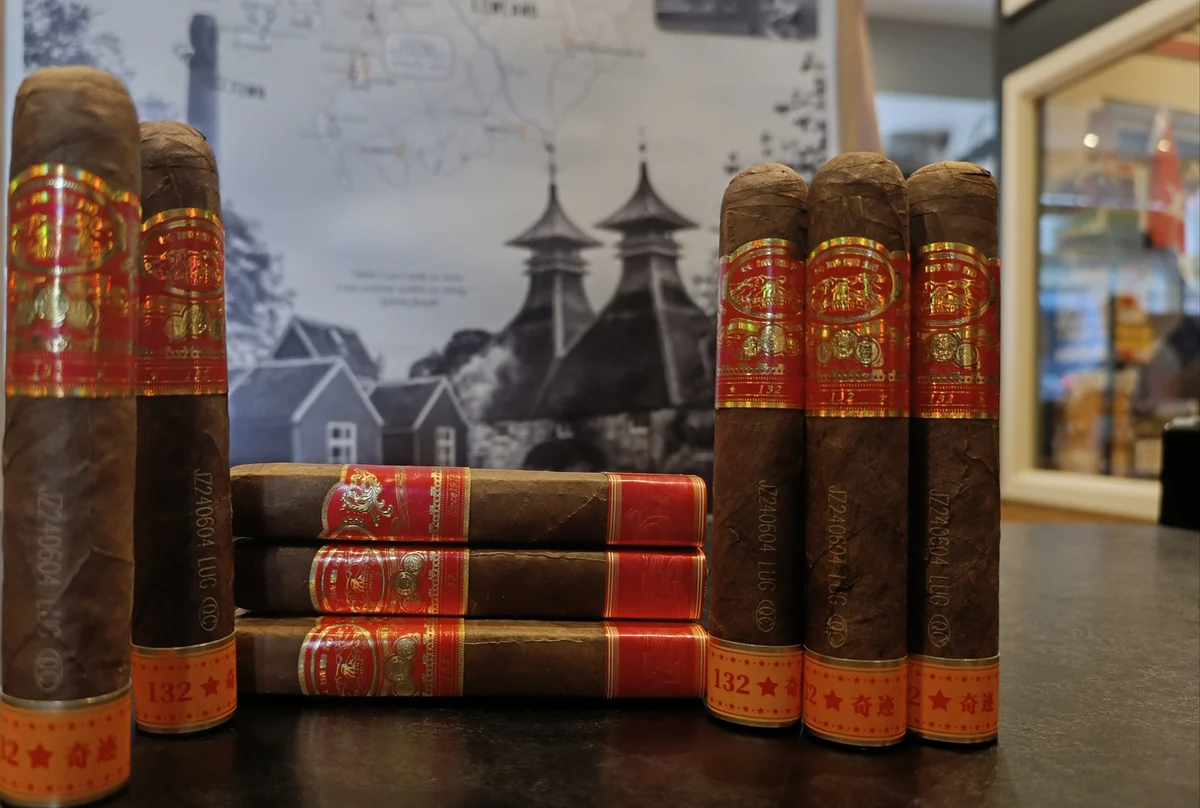
China National Tobacco Corporation has spent recent years developing domestic cigar-leaf production, improving the quality of handmade cigars, and expanding its four major cigar operations into the premium segment, according to data presented by 2Firsts, a research and consulting firm, at the InterTabac-InterSupply trade show in Dortmund, Germany.
The effort is increasingly evident from the tobacco field to the finished cigar.
China’s four major cigar operations are Great Wall under China Tobacco Sichuan, Huanghelou under China Tobacco Hubei, Taishan under China Tobacco Shandong, and Wangguan under China Tobacco Anhui. The data show that domestic producers account for more than 99% of China’s cigar market.
But volume tells only part of the story.
Machine-made cigars account for most Chinese cigar volume, while handmade cigars generate most of the value. The data showed that handmade cigars accounted for roughly 15% of volume but more than 80% of the value.
Alan Zhao, co-founder and CEO of 2Firsts, said that China Tobacco has invested heavily in recent years to improve cigar quality and pricing and to expand the domestic market. “The China cigar market is moving up the value chain,” Zhao said.
An increasingly sophisticated domestic cigar leaf industry is supporting that development.

China has been expanding specialized cigar tobacco-growing regions, placing greater emphasis on consistency and quality. Chinese leaf can account for nearly half of the blend in some domestic handmade cigars, as seen in certain brands at InterTabac. Domestic filler can reach roughly 90% in some products, and some handmade cigars are made entirely from Chinese tobacco.
The effort is not new. China began accelerating the development of domestic cigar tobacco several years ago, with cultivation programs in Sichuan, Yunnan, Hubei, and other areas targeting varieties, growing techniques, curing, fermentation, and sensory quality.
Sichuan, China’s oldest cigar tobacco-growing region, has developed the Dexue No. 1 and Dexue No. 3 varieties, which all four major Chinese cigar manufacturers have used. These varieties have played a major role in reducing China’s reliance on imported cigar wrappers and fillers. Yunnan and Hubei have also expanded specialized cigar-leaf programs and research to improve domestic raw materials.
However, the goal does not appear to be eliminating foreign tobacco.
Industry experts have reported that international leaf remains important when manufacturers need specific wrapper characteristics or flavor profiles. China is developing its domestic cigar-leaf capability while still buying substantial quantities of higher-value cigar tobacco from abroad.
That combination may be one of the clearest signs of where China’s cigar industry is headed. Under a cigar-related trade category derived from China customs data and provided by 2Firsts, imports rose from $12.1 million in 2023 to $77.9 million in 2024, then held near that level at $74.3 million in 2025.
Import volume in 2025 totaled 1.66 million kilograms, with a weighted unit value of $44.78 per kilogram.
The Dominican Republic dominated the category, accounting for 89% of its import value in 2025. Indonesia accounted for 7.7%, and Honduras for 3.3%. Zhoa cautioned that its cigar-related scope is not an official China Customs cigar-leaf category but a defined trade segment that may be relevant to the cigar market.
The Dominican connection also extends beyond purchasing tobacco.
Halfwheel’s Charlie Minato reported from InterTabac that Chinese buyers have become major purchasers of Dominican Republic cigar tobacco and that some suppliers have also provided technical expertise to China’s domestic cigar operations. Minato reported that the late Fritz Bossert of Lancaster Leaf told him that Universal Leaf had reached an agreement with the Chinese to provide technical expertise in dark air-cured tobacco.
That transfer of knowledge has accompanied noticeable changes in the cigars.
Minato wrote that his first experience with a Chinese-made cigar roughly a decade ago was poor, but that Great Wall cigars he smoked after the COVID-19 pandemic showed significant improvement. He described the newer cigars as different from typical U.S.-market products, though he said the construction was excellent.
China Tobacco is now beginning to pair its domestic development with established international cigar expertise.
At InterTabac, China Tobacco International (HK), China Tobacco Shandong, and Dominican manufacturer Tabacalera El Artista signed a strategic cooperation agreement and debuted the co-branded Taishan · Artista cigar.
The companies said the partnership will include joint product development, global premium tobacco sourcing, brand development, and international distribution. China Tobacco (HK), the publicly listed offshore subsidiary and international business platform of the state-owned China Tobacco, signed a memorandum of understanding with Artista in August to cover research and development for cigar leaf and products.
The agreement comes as China Tobacco becomes increasingly visible internationally.
China Tobacco (HK) brought more than 65 products from Great Wall, Huanghelou, Taishan and Wangguan to InterTabac this year, along with tobacco leaf representing 19 grades from three major Chinese growing regions and one region in Brazil.
Great Wall remains the heavyweight.
China Tobacco International said Great Wall accounted for more than 50% of China’s handmade cigar market in the first half of 2025 and nearly 70% of the premium handmade segment. In July 2025, China Tobacco (HK) and China Tobacco Sichuan signed an exclusive agreement granting China Tobacco (HK) global distribution rights for Great Wall outside mainland China.
The company said the agreement was intended to accelerate overseas growth and to establish a unified international platform for China’s cigar business. That expansion comes from a domestic market that operates very differently from those in the United States or in Europe.
China’s tobacco industry remains under the control of the State Tobacco Monopoly Administration and China National Tobacco Corp. Foreign handmade cigars enter mainland China through licensed imports subject to quotas, while cigars also reach Chinese consumers via surrounding markets and other “grey market” channels.
Minato reported that cigar manufacturers consistently tell him they could sell considerably more cigars in mainland China if their import quotas were larger. He also cited the often-cited figure of roughly 2 million non-Cuban cigars as China’s import limit, but noted that he has been unable to independently verify that number with Chinese authorities.
That protected domestic environment has given China’s own cigar manufacturers considerable room to grow. It also means China’s cigar story cannot be measured solely by official imports.
China is simultaneously improving its own cigar tobacco, buying premium foreign leaf, developing higher-value handmade cigars, and working with established overseas manufacturers and tobacco suppliers.
And the strategy is beginning to extend beyond China.
For years, Great Wall and other Chinese cigar brands have appeared at international trade shows without establishing a substantial presence in Western cigar markets. The latest distribution agreements and international collaborations suggest that China Tobacco wants to change that.
Whether smokers outside China embrace Chinese premium cigars remains an open question. But inside China, the direction is much clearer. The world’s largest tobacco market is building a premium cigar business.
Now it wants to see how far that business can go.