By Timothy S. Donahue
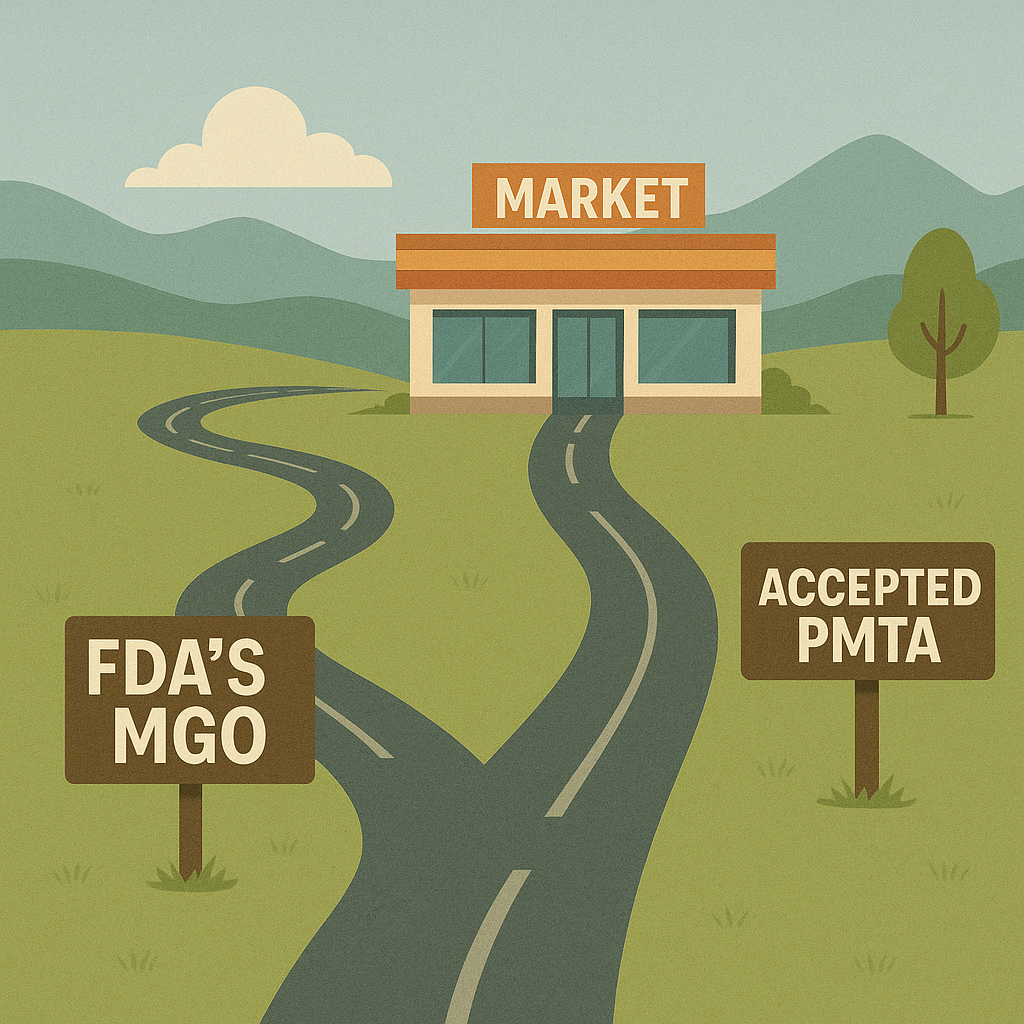
The market is now open. Major tobacco companies are increasingly treating the acceptance of a premarket tobacco product application (PMTA) by the U.S. Food and Drug Administration as equivalent to securing a marketing granted order (MGO).
The bold stance comes amid ongoing delays of FDA PMTA reviews, a growing illicit market, new product launches, and intensified legal challenges.
British American Tobacco’s (BAT) U.S. unit, Reynolds American, recently signaled the striking policy reversal. After years of vigorously opposing unlicensed disposable vapes, Reynolds is now gearing up to test‑launch its synthetic‑nicotine disposable, Vuse One, nationwide—even though the PMTA remains pending.
“Not having access to this world weighs on our company’s bottom line,” said Luis Pinto, spokesperson for Reynolds American, in an interview with Reuters. “It’s not about, if you can’t beat them, join them.”
BAT views a PMTA submission—and its prolonged FDA review—as sufficient regulatory assurance, despite enforcement delays. Pinto emphasized the company’s diligence, noting that “its approach would differ to unauthorized rivals… its products have been subject to due diligence, will be sold via large national retailers and their features and marketing will follow stricter policies.”
Still, the FDA has been clear: “A pending application does not create a ‘legal safe harbor to sell a product.’ All new tobacco products … that are on the U.S. market without the statutorily required premarket authorization … are marketed unlawfully.”
Similarly, Altria has adopted parallel tactics. Its spokesperson echoed BAT’s framing: the company regularly evaluates market opportunities in synthetic nicotine despite absent FDA authorization. CEO Billy Gifford stated earlier this year, “We’re looking at all available opportunities to assess what’s the right move in that direction.”
Altria’s Helix Innovations is applying BAT’s same legal rationale to advance its next-generation nicotine pouches, on! PLUS. The company submitted PMTAs for the line—offered in three flavors and three nicotine strengths—in June 2024, according to Altria.
Additionally, NJOY LLC, a wholly owned subsidiary of Altria Group, filed suit against FDA on August 21 in federal court in Louisiana, accusing the agency of unlawfully delaying its review of applications for flavored e-cigarettes.
The company claims such delays violate statutory time frames established under the Family Smoking Prevention and Tobacco Control Act (TCA) and unfairly block adult smokers from access to reduced-risk alternatives.
“Unless this Court orders FDA to issue a decision, some decision, on NJOY’s supervisory appeal,” NJOY’s brief to the court states. “Plaintiffs will continue to incur ongoing harm from FDA’s attempted pocket veto. Because FDA cannot use internal review to forever trap manufacturers in regulatory limbo, Plaintiffs are entitled to relief from this Court.”
The Supreme Court has recently reaffirmed judicial avenues for challenging FDA denials—particularly by parties beyond manufacturers. In the 7–2 decision in FDA v. R.J. Reynolds Vapor Co. (June 20, 2025), Justice Barrett held that retailers impacted by marketing denial orders may sue the FDA under the TCA, stating, “If the FDA denies an application, … the retailers … lose the opportunity to profit … Accordingly, the retailers are ‘adversely affected’ … and are therefore proper petitioners.”
On April 2 of this year, the Supreme Court upheld FDA’s authority to issue marketing denial orders (MDOs) for flavored e-cigarette products, deeming MDOs neither arbitrary nor capricious. Justice Alito affirmed that FDA retains broad discretion under the TCA to interpret evidence requirements and deny authorizations.
These legal developments reinforce the industry’s dual posture: while courts fortify FDA’s decision‑making power, they also open pathways for broader injury claims from industry participants.
FDA’s backlog has fueled the industry’s rationale. Since the 2020 PMTA deadline, the agency has been flooded with applications—over 26 million for electronic nicotine delivery systems (ENDS) alone—stretching its review capacity to the breaking point. The FDA has only authorized less than 40 products.
In parallel, FDA continues to issue both MGOs and MDOs, though with notable delays. The only authorized products are current or former products from major tobacco companies, including JUUL and its tobacco-flavored pods (July 17, 2025), Swedish Match’s ZYN pouches (January 16, 2025), and select NJOY menthol products (June 21, 2024). Meanwhile, blu Disposable was recently denied (August 19, 2025).